


A Different
Approach to Managing Solar Heat
A cool roof is a roofing system designed to reflect more of the sun’s energy and absorb less heat than conventional roofing.
Traditional dark roofing materials can absorb a substantial amount of incoming solar energy. As the roof becomes hotter, some of that heat is transferred into the building and some is subsequently released into the surrounding environment.
Cool roofing changes this relationship by using roof surfaces with higher solar reflectance and, where applicable, high thermal emittance. Instead of absorbing and storing as much solar heat, the roof reflects a greater proportion of incoming solar energy and more effectively releases heat that it does absorb.
The result is a roof surface that can remain substantially cooler under strong sunlight.
How Do Cool Roofs Work?
Solar Reflectance
Solar reflectance describes the ability of a roofing surface to reflect incoming solar energy rather than absorb it as heat. A roof with higher solar reflectance sends a greater proportion of that energy away from the roof, reducing the amount available to heat the roofing system and the building below.
What Is the Solar Reflectance Index (SRI)?
Solar Reflectance Index, or SRI, combines solar reflectance and thermal emittance into a single value that provides a practical indication of how hot a roofing surface is likely to become when exposed to the sun.
SRI provides a useful way to compare roof surfaces by measured thermal performance rather than relying only on colour, appearance or marketing terminology. In general, higher SRI values indicate roofing surfaces that remain cooler in sunlight.
Thermal Emittance
Thermal emittance describes the ability of a surface to release absorbed heat. A roofing material combining high solar reflectance with high thermal emittance therefore addresses solar heating in two ways: it absorbs less solar energy in the first place and can more effectively release heat that is absorbed.
Together, these characteristics help determine how hot a roof becomes when exposed to sunlight

Figure 3. Effects of a cool roof versus a dark roof.
Source: Global Cool Cities Alliance (2012), with data from Lawrence Berkeley National Laboratory.

Does a Cool Roof Have to Be White?
White roofing generally provides the highest solar reflectance, particularly for low-slope roofing systems, but cool roofing is not limited to white roofs.
Modern roofing technologies can use specially formulated surfaces and pigments that reflect portions of solar energy, including near-infrared energy that cannot be seen by the human eye. This makes it possible to produce roofing in a range of colours while providing greater solar reflectance than comparable conventional products.
However, colour still matters. As roof colours become darker, achievable solar-reflective performance generally declines. Roofing type also matters: a light-coloured membrane, coating or metal roof can achieve substantially higher performance than many asphalt shingles, even when those shingles are marketed as cool-roof products.
The central point is that two roofing products that appear to be a similar colour can perform differently, and a product that represents an improvement over a conventional dark roof may still perform far below a high-reflectance white roof. SRI allows building owners, designers and roofing professionals to compare actual measured performance.
Asphalt Shingles — An Important Performance Limitation
Not all roofing technologies can currently achieve the same level of cool-roof performance.
Asphalt shingles, which are widely used on steep-slope residential and light-commercial roofs throughout British Columbia, present a particular challenge. Conventional asphalt shingles are generally dark, solar-absorbing products, and most have much lower SRI values than white membranes, reflective coatings and many high-performance metal roofing products.
Higher-reflectance asphalt shingles have been developed for jurisdictions that recognize or require cool-roof performance. These products can represent a meaningful improvement over conventional dark shingles. Even so, their SRI values are generally much lower than those achievable with highly reflective low-slope roofing systems.
This distinction is important: a roofing product can legitimately provide improved cool-roof performance without approaching the thermal performance of a white or very highly reflective roof.
The British Columbia Product-Recognition Gap
Cool-roof performance cannot become a routine consideration in British Columbia if higher-performing products are not routinely recognized, specified, promoted or made readily available in the local roofing market.
This is particularly evident in steep-slope asphalt roofing. While rated higher-reflectance shingle products exist, cool-roof performance is not yet a normal product-selection criterion in much of the British Columbia market. Building owners may therefore receive little or no information about solar reflectance or SRI when selecting a replacement roof.
A core educational role for CoolRoofsBC is to help move roof selection beyond colour and appearance alone and toward greater awareness of measured solar performance, appropriate product choices and the opportunities available when roofs are replaced.
What Types of Cool Roofing Are Available?
Cool roofing is not a single roofing product. It is an approach to roof-surface performance that can be incorporated into different roofing systems for both low-slope and steep-slope roofs, depending on the building, roofing assembly and products available.
Reflective single-ply roofing membranes;
Reflective roof coatings;
Reflective or specially coated metal roofing;
Cool-coloured tiles; and
Higher-reflectance shingles and other roofing products engineered to improve solar performance.
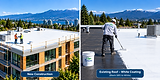
Cool Roofing for
New and Existing Buildings.
Cool roofing can be incorporated into new construction, when an existing roof is replaced, or in some cases by restoring a suitable existing low-slope roof with a high-performance reflective roof-coating system.
Reflective roof coatings should not be confused with ordinary paint. They are specially formulated roofing products designed to become part of the roof system itself. Modern elastomeric roof coatings commonly use silicone, acrylic or other polymer-based formulations selected for adhesion, flexibility, weather resistance, waterproofing performance and high solar reflectance.
Where an existing roof remains structurally and functionally suitable, a compatible reflective coating system can restore the weathering surface while also converting the roof to a high-reflectance cool roof.
Proper preparation, compatible materials and correct application are essential; not every roof or roof assembly is an appropriate candidate for coating.
Depending on the coating system, roof condition and manufacturer requirements, warranted service lives of up to approximately 20 years may be available. At the end of that period, a properly maintained roof may be capable of receiving a renewal or top-coat rather than requiring complete removal and replacement.
Periodic renewal can therefore extend the useful service life of an otherwise suitable roof and, in appropriate circumstances, may allow the existing roof system to remain in service through much of the remaining life of the building.
This approach can have important economic and environmental implications because extending an existing roof avoids or postpones the cost, disruption and material waste associated with premature tear-off and replacement.
Existing moisture, failed insulation, structural problems, extensive membrane deterioration or incompatible materials may make replacement the more appropriate option. Roof suitability should therefore be established through proper inspection and technical assessment before a coating system is selected.
Reflective coatings should not simply be applied over conventional steep-slope asphalt shingles. Coating shingles can interfere with normal drying and create moisture-related problems.

How Do Cool Roofing and Insulation Work Together?
A cool roof should not be confused with roof insulation. Insulation slows the transfer of heat through the building enclosure. Cool roofing reduces the amount of solar heat absorbed at the exterior roof surface in the first place.
The two measures can therefore work together rather than representing competing approaches to building performance. A well-insulated building can still benefit from reducing the solar heat absorbed by its roof.
Cool Roofing Is a Passive Technology
One of the defining characteristics of cool roofing is that its heat-reduction effect is passive.
Once installed, the reflective roof surface does not require electricity, mechanical equipment or occupant action to reduce solar heat absorption. Whenever solar radiation reaches the roof, the surface characteristics of the roofing determine how much of that energy is reflected and how much is absorbed.
Cool roofing does not replace air conditioning or other measures needed to protect people during dangerous heat. It does, however, reduce one of the principal ways solar heat is absorbed by buildings and accumulated across developed areas.
Cool Roofing Provided Benefits
Cool roofs can provide benefits both to individual buildings and to the communities in which they are located. These benefits can include lower roof temperatures, improved indoor comfort, reduced cooling demand, support for rooftop solar, reduced urban heat and greater resilience during extreme heat. The extent of these benefits will vary depending on climate, building design, insulation, roof type, occupancy and other factors.
Building Benefits
Lower Roof Temperatures
By reflecting more solar energy and absorbing less heat, cool roofs can remain substantially cooler than conventional dark roofs under sunny conditions. The U.S. Environmental Protection Agency (EPA) reports that highly reflective and emissive cool roofing materials can remain approximately 50 to 60°F (28 to 33°C) cooler than traditional roofing materials during peak summer weather. Conventional black asphalt roofs can reach midday surface temperatures of approximately 165 to 185°F (74 to 85°C), while high-reflectance, high-emittance cool roofs may remain closer to 110 to 115°F (43 to 46°C) under comparable conditions.
Improved Indoor Comfort
Reducing the amount of heat entering through a roof helps keep interior spaces cooler during prolonged periods of hot weather and extreme heat events. This can be particularly beneficial in buildings that lack adequate mechanical cooling. In one Sacramento two-storey apartment study cited by the EPA, installation of a cool roof reduced peak attic air temperatures by 30 to 40°F (17 to 22°C), upper-floor temperatures by approximately 4°F (2°C), and first-floor temperatures by approximately 2°F (1°C), despite the presence of substantial attic insulation.
Reduced Heat-Related Stress on Roofing Materials
SBS (styrene-butadiene-styrene) modified-bitumen roofing is widely used for low-slope roofing in British Columbia and is commonly installed with a dark-coloured surface. Under strong summer sun, these surfaces can reach high temperatures and undergo repeated cycles of thermal expansion and contraction. Over time, heat exposure can contribute to accelerated ageing and deterioration of SBS roofs, as can exposure to ponding water, a condition that is often excluded from manufacturer warranty coverage.
Reduced Cooling Demand and Energy Use
Reducing heat gain through the roof can lower the amount of energy required for air conditioning and other forms of mechanical cooling, potentially reducing both cooling costs and peak electricity demand. Research reviewed by the EPA has reported widely varying cooling-energy savings depending on building type, climate and other conditions. One review encompassing more than 25 studies found average cooling-energy savings of approximately 20%. In individual building examples summarized by the EPA, measured cooling-energy savings ranged from 10% to nearly 70%, while reductions in peak cooling demand ranged from 14% to 38%. Actual savings will vary according to factors such as building design, insulation levels, occupancy patterns and the roofing systems being compared.
Compatibility With Rooftop Solar
Cool roofing, achieved either through roof coating or the installation of a new membrane system, can be beneficially combined with rooftop solar as a complementary strategy. By maintaining lower roof-surface temperatures, reflective roofing may modestly reduce heat around rooftop photovoltaic equipment and improve operating conditions. Reflective roof surfaces can also increase the light reaching the rear side of bifacial solar panels, which are designed to generate electricity from both sides, thereby meaningfully increasing their energy yield. This additional generation depends strongly on panel orientation, mounting height, spacing, roof reflectance and local conditions, but the combination provides an additional reason to consider reflective roofing when planning rooftop solar installations.
Community Benefits
Reduced Urban Heat Island Effect
Roofs represent a significant portion of the exposed surface area in developed communities. Conventional dark roofs absorb solar energy and release heat into their surroundings, collectively increasing neighbourhood and city-wide temperatures — a phenomenon known as the Urban Heat Island Effect.
Cool roofs limit this heat accumulation by reflecting more solar radiation and absorbing substantially less heat. Lower roof-surface temperatures reduce heat transfer into buildings and the subsequent release of stored heat into the surrounding air, particularly into the evening and overnight. Widespread adoption of cool roofing can therefore contribute to cooler neighbourhoods, especially in densely developed areas with extensive roof coverage.
Reducing urban heat can also lower air-conditioning demand, ease peak pressure on the electrical grid and improve conditions in buildings without adequate cooling. Although not a complete solution, cool roofs can form an important part of a broader strategy incorporating increased tree cover, shaded public spaces, reflective pavements, green infrastructure and improved building performance.
Support for Extreme-Heat Adaptation
By reducing heat gain within buildings and contributing to cooler urban environments, cool roofs can play an important role in broader strategies for adapting buildings and communities to increasingly hot summers and more frequent extreme-heat events.
New York City’s NYC CoolRoofs program provides a significant real-world example of cool roofing being implemented as an urban heat-adaptation strategy. Launched in 2009, the program applies highly reflective white coatings to suitable rooftops to reduce roof-surface and indoor temperatures, lower building energy consumption and help mitigate the Urban Heat Island Effect. Since its launch, the program has applied reflective coatings to millions of square feet of suitable rooftop area while combining heat mitigation with workforce training. New York City identifies cool roofing as an important component of its broader efforts to reduce heat-related impacts and improve building performance and resilience during periods of hot weather.
Reduced Peak Electricity Demand
Widespread reductions in building cooling requirements can help lower electricity demand during hot weather and extreme heat events, when cooling systems and electrical infrastructure are under their greatest strain. During British Columbia’s 2021 Heat Dome, peak summer electricity demand reached record levels on June 28, 35% above the then seasonal average. Research examining the event identified approximately 400 unplanned outages affecting more than 40,000 customers that day, compared with a daily average of about 50 outages affecting 1,000 customers during the preceding week.
The U.S. Environmental Protection Agency also cites Lawrence Berkeley National Laboratory modelling estimating that widespread adoption of cool roofs across the United States could reduce national peak electricity demand by 6.2 to 7.2 gigawatts — equivalent to the generating capacity of approximately 12 to 14 large 500-megawatt power plants.
Healthier, More Resilient Communities
Cool roofs are not a substitute for air conditioning, shade, trees, building-envelope improvements or other heat-protection measures. When used alongside these strategies, however, they can help reduce heat exposure, lower cooling demand and associated costs, ease peak pressure on electrical infrastructure and improve conditions in buildings without adequate mechanical cooling. Collectively, these benefits can contribute to healthier, more comfortable and more climate-resilient communities.


Why Cool Roofing Matters in British Columbia
Cool Roofing as a Practical Climate-Adaptation Measure
British Columbia is already experiencing rising average temperatures and more frequent, prolonged and intense periods of extreme heat. The 2021 heat dome demonstrated how quickly extreme heat can become a public-health emergency, compromise building performance and strain critical infrastructure. Preparing for future events requires both effective emergency response and practical measures that reduce heat exposure before dangerous conditions develop.
Cool roofing is one such measure. By reducing the solar energy absorbed at the roof surface, a suitable cool roof can help limit heat gain within a building and reduce the heat subsequently released into the surrounding environment. It is not a substitute for insulation, ventilation, mechanical cooling, shade, trees or other heat-protection measures. Its value lies in providing a durable, passive layer within a broader heat-resilience strategy.
01
When Extreme Heat Becomes an Indoor Emergency
Extreme heat is often perceived as an outdoor-weather problem, yet its most serious consequences can occur indoors. The BC Coroners Service identified 619 heat-related deaths in British Columbia during the summer of 2021. Almost all of the fatal heat exposures occurred inside residences, with excessive indoor temperatures identified as the primary cause of injury and death during the extreme-heat event.
This experience demonstrated that building performance — particularly the ability of homes and community facilities to limit heat gain and release accumulated heat — is a matter of public interest. Roofs are not the complete solution, but they are among the building surfaces most directly exposed to summer sun. How they are designed, maintained and renewed should therefore form part of heat-adaptation planning.
01
Every Roofing Decision Is a Long-Term Opportunity
Each year, roofs across British Columbia are constructed, replaced, repaired or restored. Decisions made at these points can remain in place for decades. This creates a recurring opportunity to consider solar reflectance and thermal performance alongside waterproofing, durability, appearance, cost and other project requirements.
The objective is not to replace serviceable roofs prematurely or prescribe a single roofing solution for every building. It is to ensure that cool roofing is considered whenever a roofing decision is being made. For some buildings, this may mean selecting a high-performance cool roof for new construction or roof replacement. For others, it may mean determining whether a suitable reflective roof-coating system can restore and extend the service life of an existing roof.
01
More Informed Roofing Decisions
Cool-roof performance cannot become a routine consideration in British Columbia unless higher-performing products are consistently recognized, specified, promoted and readily available. This is particularly important in steep-slope roofing, where products are often presented to owners primarily by colour, style, warranty and price, with little or no information about solar reflectance or Solar Reflectance Index (SRI).
The issue is not simply whether suitable products exist, but whether owners, designers, contractors, suppliers and public purchasers can readily identify and compare them when roofing decisions are being made. Clearer product information and greater market recognition of cool-roof performance would support more informed choices while preserving the need to assess each roof according to the local climate, roof assembly, condition, building use and available budget.
01
Cool Roofing Across British Columbia’s Different Climates, Communities, and Buildings
British Columbia’s size, geography and varied topography produce substantial differences in climate across the Province. Coastal communities generally experience milder winters and wetter conditions, while many Interior and northern communities face greater seasonal temperature extremes. Elevation, latitude, proximity to the ocean and local weather patterns also influence summer heat, winter temperatures, precipitation, solar exposure and wildfire-smoke conditions.
The Province’s communities and buildings are equally diverse. Urban density, access to shade, energy sources, construction practices, building age and roof design all affect how buildings respond to heat. Cool roofing should therefore not be approached as a single solution applied in the same way everywhere. Its suitability, expected benefits and specifications should be evaluated for the particular climate, building, roof assembly and community in which it will be used.
01
Public Buildings Can Lead
Municipal buildings, schools, healthcare facilities, community centres, supportive housing, non-profit buildings and other public-serving properties can play an important role in advancing the use of cool roofing across British Columbia.
Many of these buildings serve people who are particularly vulnerable to heat or may have limited access to safely cooled indoor environments. Collectively, they also provide highly visible opportunities to demonstrate, monitor and evaluate practical heat-adaptation measures.
01
Reducing Normal and Peak Electricity Demand
Cool roofing can provide buildings with significant annual energy savings by limiting solar heat absorption and reducing building cooling requirements. These benefits become particularly important during summer and extreme heat events, when increased reliance on air conditioning can substantially increase electricity demand. During British Columbia’s 2021 extreme-heat event, BC Hydro reported an approximate 8% demand increase over the previous summer peak record and an increased number of service disruptions.
Cool roofs cannot eliminate peak demand, and their effect varies by building. However, reducing avoidable solar heat gain can complement efficient cooling, heat pumps, insulation, shading and demand-management measures. At scale, passive measures can contribute to a more balanced approach: improving the building first while planning responsibly for the energy needed to keep occupants safe.

More Than Awareness Required
Cool roofing will not become a routine part of roofing decisions in British Columbia through awareness alone. Progress will require coordinated action to make credible information readily accessible, suitable products easier to identify and cool-roofing options more consistently considered.
Important enabling steps include:
Providing clear, independent education for building owners, designers, contractors, suppliers and decision-makers
Undertaking British Columbia-based demonstrations and performance monitoring across different building and roofing types
Providing consistent product information based on recognized measures of solar performance
Incorporating cool-roofing considerations into public procurement, extreme-heat planning, building policy and incentive programs; and
Encouraging collaboration among industry, governments, researchers, utilities, community organizations and building owners.
Together, these measures can build confidence in cool roofing without overstating its performance or suggesting that it is appropriate for every building. These measures can also help ensure that roofing investments made today are evaluated against the hotter conditions British Columbia is increasingly expected to experience in the future.

Decision-Making With the Future in Mind
British Columbia’s roofs will continue to be repaired and replaced, whether or not solar performance is considered. The practical question is whether these routine investments will also help prepare buildings and communities for the increasingly hot conditions the Province faces.
By incorporating cool roofing into everyday design, procurement, maintenance and roof-renewal decisions, British Columbia can make better use of investments already being made. The opportunity is incremental but potentially significant — one suitable roof at a time, supported by credible information, local evidence and informed decision-making.
©CoolRoofsBC 2026